
Beyond “Fine”: How Naming Emotions With Precision Changes Everything
- Lana Vose
- Nov 24, 2025
- 7 min read
by Lana Vose
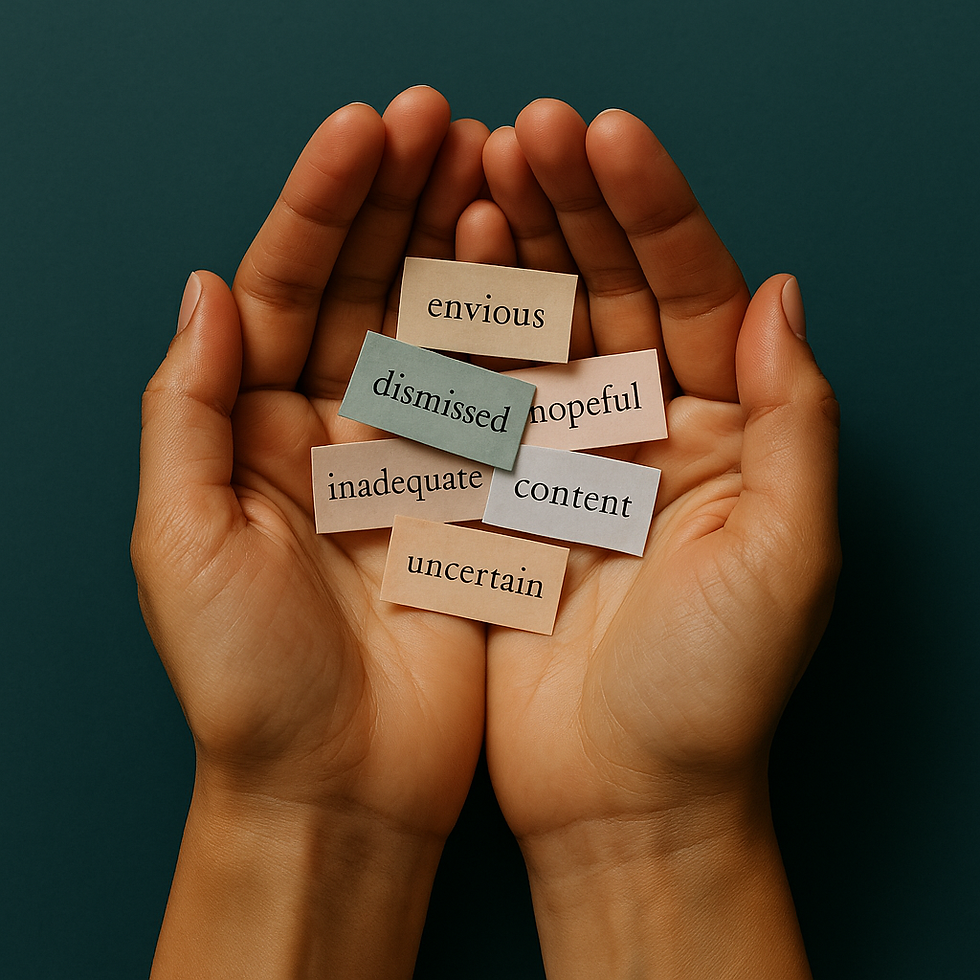
Your colleague sends another “quick question” email at 6 p.m. The workday should be over, but your screen lights up again. Heat gathers in your chest, your shoulders climb toward your ears, and your breath catches in a tight, shallow rhythm. You close the laptop harder than you meant to.
Later, someone asks how you are. The words arrive on autopilot: I’m fine. I’m stressed. It’s nothing.
These phrases cover the surface, but they don’t tell the truth. Underneath lives something more specific—resentful, trapped, unappreciated, afraid of disappointing people—that never reaches language.
The gap between what the body feels and what the mouth can say is the territory of emotional awareness. Learning to name emotions with precision is how we cross it.
A First Naming Experiment
Before we explore the science, try a brief experiment. The experience will make the research that follows more tangible.
Think of a recent situation when you said, I’m fine, I’m stressed, or I feel bad. Bring the scene into focus: where you were, who else was there, what was happening.
Now notice your body as you recall it. Where do you feel that moment most—throat, chest, stomach, jaw, hands? Describe the sensation as if you had to put it on a page: “dense pressure in my chest,” “hollow space in my stomach,” “heat behind my eyes,” “buzzing under my skin.”
Then ask: What emotion matches this pattern best? Offer yourself three options—overloaded, trapped, resentful… or anxious, exposed, discouraged—and choose the closest fit.
You have just taken your first step into affect labeling: putting feelings into words.
What Happens in the Brain When You Name Emotions
Emotions begin as biology.
Before a single word appears, your nervous system reacts. Heart rate shifts. Muscles brace or go limp. Breath speeds up or stalls. The digestive system adjusts. The amygdala—the brain’s alarm center—fires quickly, assigning urgency before you have any clear story about what is happening.
Language comes later.
Neuroscientists call the act of turning raw feeling into words affect labeling. When you say, even silently, I feel overlooked, I feel ashamed, I feel envious, the prefrontal cortex engages. This region supports perspective, decision-making, and self-regulation. At the same time, measured activity in the amygdala decreases.
In everyday terms:
The alarm system lowers its volume.
The part of you that can choose a response steps forward.
This is very different from emotional suppression. Suppression relies on tension and avoidance. It tells the body, this is not happening, while the nervous system stays on high alert underneath. Naming emotions does the opposite. It acknowledges the experience and signals, I see what is happening, and I can stay with it.
UCLA’s affect labeling studies and Lisa Feldman Barrett’s emotional granularity research reveal a consistent pattern: people who name emotions precisely regulate their feelings more effectively, react less impulsively, and recover from setbacks faster. The brain works better with accurate information than with vague distress.
Why Precision Matters
“I’m stressed” often hides an entire crowd of experiences.
That midnight pacing after a deadline email might be:
Overloaded – there is more work than time.
Trapped – you overpromised and feel unable to step back.
Inadequate – you fear your work will be judged harshly.
Resentful – you keep staying late while others log off on time.
Each one feels different in the body. Each one points toward a different next step. Overloaded asks for prioritizing. Trapped asks for boundaries. Inadequate asks for support or skill-building. Resentful asks for an honest conversation.
This capacity to distinguish between similar states is called emotional granularity. It doesn’t require a huge vocabulary. It requires paying attention to nuance. When you shift from “I feel bad” to “I feel excluded,” you move from a dead end to information you can work with.
Children exposed to rich emotional language often develop this skill earlier. But if you grew up with “We don’t talk about feelings,” or in a culture that prizes stoicism and emotional restraint, you may feel shame about struggling to name emotions.
Nothing is wrong with you. You learned to survive in a specific environment. Building emotional vocabulary now is not failure; it is re-education. In many families and cultures, it is also a quiet act of rebellion.
Different cultures name emotional experiences differently. Some have words for shared sorrow, longing, or subtle social shame that other languages cannot translate easily. If finding the right word feels hard, it may be because your inner world doesn’t fully match the emotional language you were given.
For trauma survivors, naming emotions too quickly can feel destabilizing. If that’s true for you, it may be wise to move slowly and, when possible, explore this work with a therapist or trusted guide. Naming emotions is a tool, not a test.
Practices to Expand Your Emotional Vocabulary
These four practices approach naming emotions from different angles. You can experiment and see what fits your life right now.
1. The Sensation-to-Language Check-In
This is your foundational practice: starting with the body, then moving toward words.
How to practice:Scan your body from the inside out. Where is the strongest sensation—chest, throat, stomach, jaw, hands? Describe it clearly: “sharp pressure in my chest,” “tight ring around my throat,” “heavy drop in my stomach.”
Then ask three questions:
Where is it strongest? (Chest? Throat? Stomach?)
What is it doing? (Tightening, pulsing, holding, rising, sinking, spreading?)
Which emotion matches this pattern?
Offer three options—trapped, resentful, exhausted—and choose the closest fit. If nothing fits, use “somewhere between ___ and ___” to approximate.
What’s happening:You begin where emotion actually starts—in the body—and use language to organize the experience. This is affect labeling in its most direct form, strengthening the bridge between physical sensation and conscious understanding.
2. Expanding Beyond Basic Labels
This practice builds emotional granularity by upgrading the broad labels you rely on most.
How to practice:Pick one common word you use often—angry, sad, stressed, or anxious. Write it at the top of a page. Underneath, list more specific versions.
For example:
Angry → irritated, resentful, provoked, outraged, indignant
Sad → disappointed, grieving, lonely, discouraged, heartsick
Anxious → uneasy, worried, panicked, on edge, dread-filled
When you catch yourself thinking or saying the broad word, check in with your list. Ask: Which option matches this situation more closely?
What’s happening:You train your mind to see finer distinctions. Over time, the nervous system starts to sort your experiences more accurately on its own, improving emotional awareness and decision-making.
3. Branching Map Practice (Feelings Wheel Mindfulness)
This practice uses the same branching structure you’d see in a feelings wheel diagram, whether or not you look at one.
How to practice:When you notice an emotion, start with a basic category: angry, sad, afraid, joyful, disgusted, surprised.
Then branch outward to specifics. For example:
Anger → frustrated, resentful, bitter, outraged, indignant
Sadness → disappointed, grieving, lonely, heartsick, nostalgic
Fear → worried, panicked, uneasy, anxious, dread
Ask: Which branch word is closest to what I feel right now?
You can search for “feelings wheel” later to see visual versions of this structure and even print one for your journal. The core practice, though, is simple: move from general to specific with curiosity. This is feelings wheel mindfulness—using a mental map to stay present with nuance instead of collapsing everything into “bad” or “stressed.”
What’s happening:You anchor attention in exploration rather than avoidance. The brain learns that emotional complexity is safe to approach and possible to understand.
4. The Context Decoder
Emotions carry information about values, needs, and boundaries. This practice links emotion to what is happening around you.
How to practice:When you name an emotion, add one sentence: I feel ___ because ___.
For example:
“I feel resentful because I stayed late again while everyone else left on time.”
“I feel inadequate because I’m comparing myself to people online instead of my own path.”
“I feel overloaded because I keep saying yes when I want to say no.”
You are not locking yourself into a story. You are forming a working hypothesis: Given this context, what might this emotion be pointing to?
What’s happening:You begin to see emotions as signals rather than verdicts. Instead of drowning in feeling, you read it as data about what matters to you.
What This Looks Like in Daily Life
When an emotion finally meets the right word, something often shifts.Your breath deepens. Your shoulders lower. Thoughts feel less tangled. The body recognizes coherence: Yes. That’s what this is. The feeling remains, but it has form now.
That shift shows up first in small, ordinary moments:
You snap at your partner about the dishes—again. Your voice has that sharp edge you recognize and dislike. You stop mid-sentence and notice heat behind your eyes, tightness in your throat. Annoyed doesn’t fit. The real word is unseen. You’ve been carrying the mental load of the household, and the dishes are where it leaks out. You try again: “I think I feel unseen in how much I’m managing.” The conversation moves from plates to partnership.
Your manager offers you a “great opportunity” in a meeting. The words sound flattering. Your stomach responds with a hard knot. You catch the urge to say yes immediately. You notice the sensation: tight, twisting, heavy. The words uncertain and overcommitted surface. You say, “I need to check my bandwidth—I’m stretched right now. Can I get back to you tomorrow?” Naming the emotion protects you from overriding your own limits.
A friend cancels plans for the third time in a row. You feel a hollow drop in your chest and hear yourself say, “No worries, it’s fine.” Later, you sit with the feeling. The word fine disintegrates. What remains is unimportant and disappointed. Writing that down in your journal doesn’t solve the friendship, but it tells the truth. From there, you can decide whether to speak up, recalibrate expectations, or grieve a shift in the relationship.
As you practice, you will still hear yourself say tired, stressed, fine. Instead of treating those words as the end, treat them as the first draft. Pause internally, scan your body, and search for a more accurate word. Over time, the distance between feeling and naming shrinks. Language becomes a daily instrument of emotional awareness rather than a mask.
Reflection Invitation
In your journal consider exploring these questions:
Which emotions do you name easily, and which ones feel vague or tangled?
Where do you collapse many experiences into “stressed,” “tired,” or “fine”? What might live underneath those words?
When you name an emotion precisely, what shifts in your body, even slightly—breath, posture, tension, energy?
What new emotional words have you encountered lately—in reading, conversation, or therapy—and how have they changed the way you understand your inner life?
The body speaks first: tight jaw, burning chest, hollow stomach, restless legs. For years, those signals may have passed through you unnamed, covered by phrases like I’m fine or It doesn’t matter.
Naming emotions does not erase what we feel. It offers clarity where there was blur. Through the practice of putting feelings into words, we learn to navigate an inner landscape that once felt chaotic and uncharted.
Begin now. Notice what you feel as you finish reading. Where does it land in your body? What is its exact flavor? Find the most accurate word you can.
That single act is the work.


Comments